🎁 Give the Gift of Health & Strength
Shop Gift Cards
3 kg vs 20 kg: What Really Matters for Building Muscle?
Many women avoid lifting heavy because they're afraid of becoming bulky, while others believe light weights can't build muscle. In this article, I share my personal experience and explain the science behind strength training, nutrition, and protein supplementation to help you understand what really supports muscle growth.
Harmony Fitness
7/19/20266 min read
What I Learned
✔️ Lift weights that challenge you.
✔️ Eat enough to recover.
✔️ Prioritise protein.
✔️ Whole foods come first whenever possible.
✔️ Protein powder is a supplement—not a replacement for a balanced diet.
✔️ Consistency beats perfection.
Need help building muscle, losing body fat, or improving your nutrition?
Everyone's body, lifestyle, and nutrition needs are different.
Whether your goal is to gain muscle, lose body fat, improve your strength, or simply feel healthier, having a personalised plan can make the process much easier.
Through my online personal training, I'll help you with:
Personalised strength training programmes
Nutrition guidance based on your lifestyle
Sustainable habits—not quick fixes.
Weekly support and accountability
Safe progression for long-term results
📩 Get in touch to start your personalised online coaching with Harmony Fitness.
Online Personal Trainer for Women
Myth 1: Heavy Weights Make Women Bulky & Light Weights Don't Build Muscle
Myth 2: Protein powder is magic. Protein powder builds muscle.
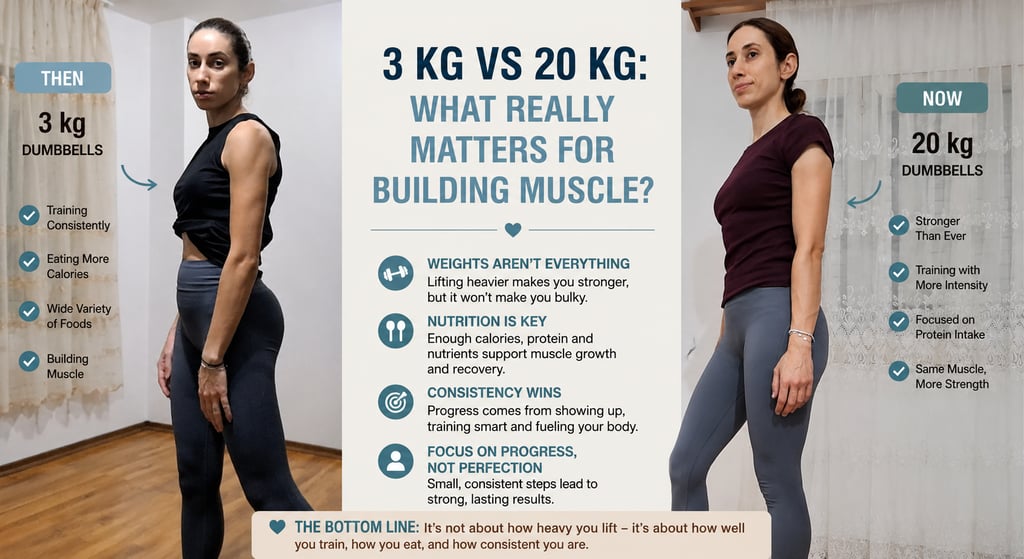
f I showed you these two photos without any explanation, what would you assume?
Most people would probably think the photo on the right came after years of muscle gain.
The truth is…
The story is more complicated than it looks.
On the left, I was lifting only around 3 kg.
On the right, I'm comfortably training with 10–20 kg, yet I actually have less muscle mass.
This experience taught me one of the biggest lessons in fitness:
Training alone isn't enough. Your body also needs enough fuel to build muscle.
Myth 1: Heavy Weights Make Women Bulky & Light Weights Don't Build Muscle
❌ False
One of the biggest misconceptions I hear is:
"If I lift heavy, I'll look like a man."
Or the opposite:
"If I only lift light weights, I won't build any muscle."
Neither statement is true.
In my case, the photo on the left was taken when I was mainly training with 3 kg dumbbells. Even with lighter weights, I was able to build muscle because I trained consistently, challenged my muscles, and supported my training with enough nutritious food.
On the right, I'm lifting around 10–20 kg. I'm much stronger now, but becoming stronger doesn't automatically mean you'll gain large amounts of muscle. Muscle growth depends on several factors, including progressive overload, nutrition, recovery, genetics, and consistency.
For most women, lifting heavier weights won't make them look masculine. Women naturally produce much lower levels of testosterone than men, making it much more difficult to build large muscles. Instead, strength training helps create a stronger, leaner, and more toned physique while improving bone health, metabolism, and everyday function.
The key isn't choosing light or heavy weights—it's choosing a weight that challenges you while allowing you to maintain good technique. As you become stronger, gradually increasing the challenge (known as progressive overload) is what encourages your muscles to adapt.
Whether you're lifting 3 kg or 20 kg, the most important question is:
"Is this weight challenging enough for me today?"
The best weight is the one that challenges you while allowing you to maintain good technique and gradually progress over time.
Strength and Muscle Are Not the Same Thing
Another important lesson is that strength and muscle size aren't identical.
You can become significantly stronger because:
Your nervous system becomes more efficient.
Your technique improves.
Your coordination increases.
Your muscles learn to work together better.
These adaptations happen even if muscle growth is limited.
That's why I can lift much heavier today than I could years ago, despite having same muscle mass and less weight.
The biggest difference wasn't my training.
It was my nutrition.
Food Is Part of Your Training
People often ask me:
"What's the best exercise for building muscle?"
My answer is always the same:
The workout starts in the kitchen.
Training provides the stimulus.
Nutrition provides the building blocks.
Recovery allows your body to adapt.
Without all three, progress becomes much slower.
One thing these photos don't show is that I've also lost around 5–6 kg over the past five months. It wasn't intentional. My lower calorie intake made it difficult to maintain my weight, despite becoming significantly stronger. It was a valuable reminder that strength and body weight don't always change in the same direction, and that nutrition plays a huge role in both performance and body composition.
What I Would Do Differently
If I could change one thing, it would be making sure I consistently eat enough quality food.
My priorities would be:
Protein with every meal
Plenty of fruit and vegetables
Whole-grain carbohydrates for training energy
Healthy fats
Enough total calories to support recovery
The weights matter.
But your nutrition matters just as much.
My Advice to You
If you're training consistently but not seeing the results you expected, don't immediately assume your workouts are the problem.
Ask yourself:
Am I eating enough?
Am I getting enough protein?
Am I recovering properly?
Am I sleeping enough?
Sometimes the missing piece isn't another workout.
It's giving your body the fuel it needs to grow.
Myth 2: Protein powder is magic (maybe I expected too😅). Protein powder builds muscle.
Not exactly.
Protein powder is a supplement—not a shortcut.
It can help you increase your protein intake when food choices are limited, but it cannot replace enough calories, balanced meals, or consistent training.
When I was living abroad, I had easy access to a wide variety of foods.
I was eating around 2,000–2,500 calories per day, including:
Chicken and other lean meats
Dairy products
2-3 Fresh fruits every day
Plenty of vegetables
Balanced meals
My body had enough energy to recover from training and support my progress.
Before moving home, I rarely used protein powder. If I wanted extra protein, I'd usually choose foods like high-protein yogurt or natural products instead.
Now I'm living in a village, where my food choices are more limited. Also, my meals are generally based on wholesome, home-cooked foods. While that's great for overall health, they're often lower in calories than meals I used to prepare for myself abroad. I also have fewer opportunities to snack throughout the day or choose foods that are naturally higher in protein and calories.
Because I knew from previous visits that I tend to lose weight while staying here, I decided to use protein powder regularly 😅 this time not because I believe it builds muscle on its own, but simply as a practical way to increase my protein and calorie intake when I can't prepare a balanced meal.
I'm still seeing how it works for me, so I can't honestly say whether it's the right solution yet. What I do know is that whole foods remain my first choice whenever possible.
One thing I did notice during this period was that I recovered better after my workouts and experienced less muscle soreness. While I can't say for certain that protein powder was the only reason, increasing my protein intake may have helped support muscle recovery, especially on days when it was difficult to get enough protein from whole foods.
This reminded me that supplements can be useful when they're used to complement a balanced diet, not replace it. Your body needs enough total energy, protein, carbohydrates, healthy fats, vitamins, and minerals to recover and grow.
One of the Most Common Mistakes I See as a Personal Trainer
When new clients join my coaching, one of the first things we do is track their food for a week using MyFitnessPal. The goal isn't to judge what they're eating—it's to understand their current habits and identify realistic changes that will support their goals.
After reviewing their food diary together, many clients naturally start making healthier choices. They swap processed snacks for fruit, include more vegetables, choose lean proteins, and reduce sugary drinks. These are all positive changes.
However, I often notice another problem.
Some clients begin to think that healthy eating means eating as little as possible.
They cut out the junk food... but they also cut out meals.
Instead of replacing unhealthy foods with nutritious alternatives, they simply eat much less overall.
This is where progress often stalls.
If you're eating too few calories, your body has less energy for daily life, workouts become more difficult, recovery slows down, and building or maintaining muscle becomes much harder.
That's why I don't just focus on what my clients eat—I also look at how much they're eating.
My own experience reminded me of this. Even though I was lifting heavier weights, eating too little made it difficult to create the ideal environment for building muscle.
Healthy eating doesn't mean starving yourself.
It means giving your body the nutrients and energy it needs to become stronger while supporting your overall health.
I don't want my clients to simply lose weight.
I want them to lose body fat, preserve muscle, become stronger, and build habits they can maintain for life.
If you'd like to learn more about energy balance and metabolism, you might also enjoy my blog "What Slows Metabolism? Improve It Now!", where I explain how daily habits, nutrition, and strength training influence metabolism.


Harmony Fitness
Online Personal training for women who want to transform their health and build lasting fitness habits.
Connect With Me
Get notified about news! No spam, just motivation!